


Most Ohio families leave hundreds of dollars on the table every year, not because they earn too little, but because no one showed them the right system. Here’s what actually works.
To save money in Ohio, start by tracking exactly where your money goes, and reduce utility bills with simple home fixes. Ohio families who combine consistent budgeting with a community bank like First National Bank of Germantown tend to build savings faster because they get personalized guidance, not one-size-fits-all products.
Saving money in Ohio isn’t complicated, but it does require a system. Whether you’re in Germantown, Dayton, or any small town in between, the same few habits separate people who steadily build savings from those who wonder where their paycheck disappeared. At First National Bank of Germantown, we’ve been working with Ohio families for decades. We’ve seen every financial situation, and the patterns are clear. Below are the 10 strategies that consistently work, and why.
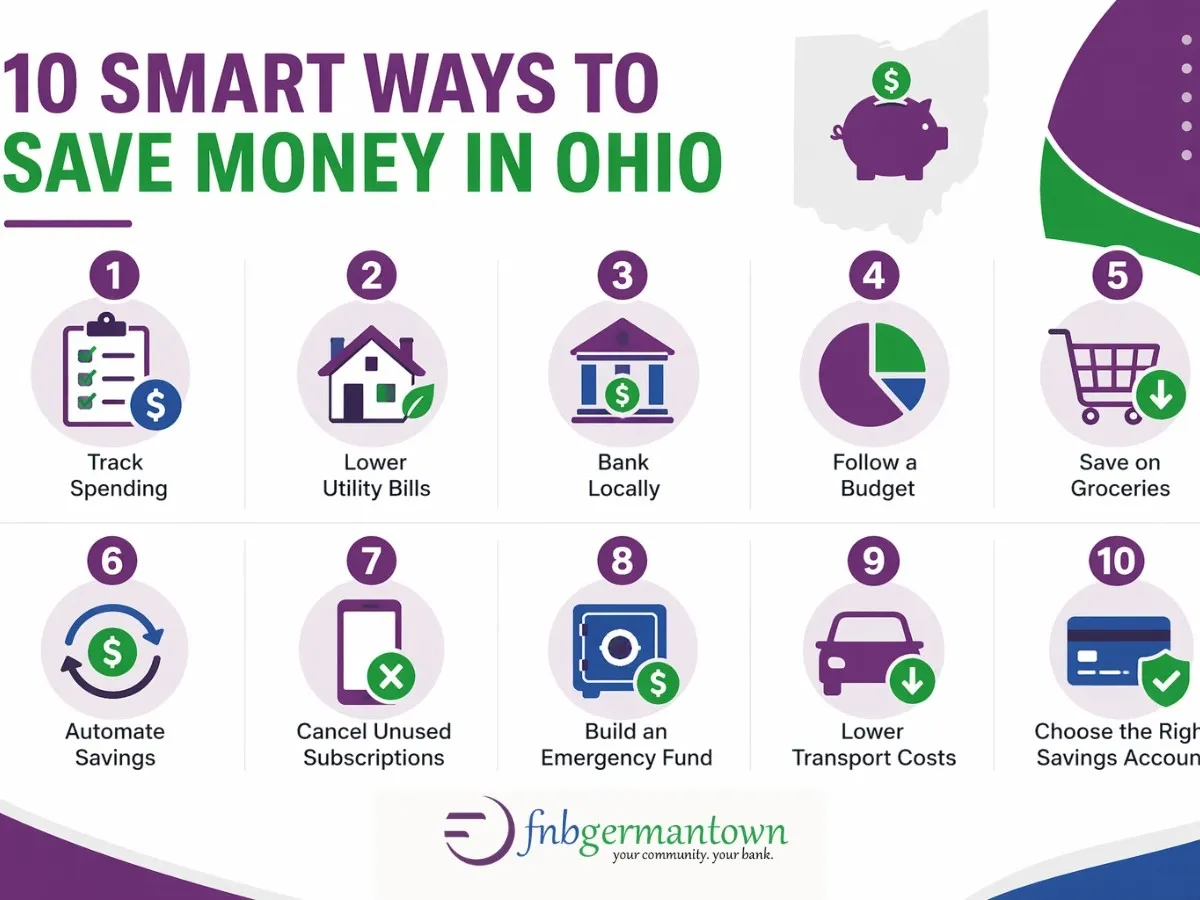
10 Smart Ways to Save Money in Ohio
1. Get Spending Clarity Before Anything Else
You cannot fix what you cannot see. Before setting a budget or opening a new account, spend one week writing down every single purchase: coffee, gas, a random Amazon order at midnight. All of it.
Most families in Ohio are shocked to discover they’re spending $300–$400 more per month than they thought. Subscriptions stack up. Convenience spending accumulates quietly. Awareness alone drives change.
- Track housing, utilities, groceries, and subscriptions separately
- Use a simple notes app or a notebook; no special tool is required
- Do this for 30 days before touching your budget
Ohio-specific insight: Many families in smaller towns like Germantown underestimate transportation costs. Gas, maintenance, and trips to Dayton or Cincinnati add up to a hidden monthly expense.
3. Reduce Utility Bills: Ohio Winters Are Expensive
Ohio’s winters hit hard, and heating bills are one of the biggest drains on a household budget between November and March. The good news: most fixes are one-time efforts with year-round payoffs.
- Install a programmable or smart thermostat (pays for itself quickly)
- Seal gaps around doors and windows with weatherstripping
- Add attic insulation if your home is older than 20 years
- Run large appliances, dishwashers, and washing machines during off-peak hours
These changes won’t just lower your bill this winter. They reduce your monthly utility burden permanently, which means more room in your budget every single month.
4. Choose a Bank That Works With You, Not Just for You
This is where most people in Ohio leave real money behind. Big banks are built for volume; you’re an account number, not a neighbor. Community banks are different by design.
At First National Bank of Germantown, our team sits down with you. We help you set up savings structures that match your life, not a generic product built for millions of strangers. Decisions are made locally, which means faster approvals and actual conversations.
“The team is professional, smart, and the best part they treat you like family. You will not find this in a big bank.”
5. Build a Budget You’ll Actually Follow
The problem with most budgets isn’t math; it’s that they’re too rigid. Life in Ohio doesn’t follow a spreadsheet. Car repairs happen. Kids need things. Use a flexible framework instead.
The 50/30/20 rule is a solid starting point:
- 50% of take-home pay → needs (housing, utilities, groceries, transportation)
- 30% → wants (dining, entertainment, hobbies)
- 20% → savings and debt payoff
Adjust these percentages for your specific situation. If you’re carrying debt, push more toward the 20% category temporarily. The goal is consistency, not perfection.
6. Cut Grocery Costs Without Eating Worse
Groceries are one of the most controllable expenses in any household, yet most Ohio families overspend here by 20–30% simply due to habit and impulse buying.
- Plan meals for the week before you shop, even just roughly
- Buy staples (rice, beans, pasta, canned goods) in bulk from warehouse stores
- Shop store brands instead of name brands for pantry items
- Don’t shop hungry; it sounds cliché because it genuinely costs people money
Local tip: Farmers’ markets near Germantown, especially during the summer months, often offer better produce at lower costs than chain grocery stores.
7. Automate Your Savings (This Is the Real Secret)
Manual saving requires willpower every single month. Automation removes that friction entirely. When savings happen automatically before you even see the money, you stop thinking of it as an option.
- Set up an automatic transfer on payday to your savings account
- Keep savings in a separate account from checking, out of sight, out of mind
- Even starting with a small amount builds the habit and the balance
Our team at FNB Germantown can help you set this up in minutes. Once it’s running, saving becomes something that happens to you, not something you have to remember to do.
Set up automatic savings at FNB
8. Cancel Subscriptions You’ve Forgotten You Have
Go through your last two bank statements right now. You will almost certainly find at least one or two subscriptions you forgot about, a streaming service, a fitness app, or a trial that auto-renewed.
The average American household pays for 4–6 subscriptions they rarely or never use. Canceling them doesn’t require sacrifice. It just requires ten minutes and a careful look at your statements.
- Review streaming services. Do you use all of them?
- Check app stores for recurring app charges
- Look for “premium” upgrades on free tools you barely use
9. Build an Emergency Fund Before Investing in Anything Else
An emergency fund is the most important financial safety net you can build, more important than chasing high returns or paying off low-interest debt early. Without it, one car repair or medical bill can undo months of savings progress.
- Target 3–6 months of essential expenses
- Keep it in a separate, accessible savings account
- Don’t touch it except for genuine emergencies
Once your emergency fund is in place, unexpected expenses become manageable inconveniences, not financial crises.
10. Lower Transportation Costs Strategically
In smaller Ohio towns, a car is a necessity, not a luxury. But how you manage that car makes a significant difference in your monthly budget.
- Combine errands into single trips to save fuel
- Stay on top of routine maintenance, it prevents expensive repairs
- Carpool for regular commutes when possible
- Consider refinancing your auto loan if rates have changed since you bought it
Ask our team at FNB Germantown about auto loan options. Local lenders often offer more flexibility than dealership financing.
10. Choose the Right Savings Account, Not Just Any Account
A savings account should do more than hold your money. Look for an account with no hidden fees, easy access, and a team behind it that can guide you when your financial situation changes.
This is exactly what community banking is designed to provide. When you bank locally in Germantown, your deposits stay in the community. The team knows your name. And when you need guidance, not just a balance update, there’s an actual person to call.
Why Most Ohio Residents Struggle to Save

After working with Ohio families across multiple generations, the patterns are consistent. Saving money rarely fails because of income. It fails because of the system and structure.
Common Problems
- No consistent tracking system
- Saving what’s “left over” (there’s never enough left)
- Using the wrong account for savings
- No emergency fund as a buffer
- Banking with institutions that don’t know them
What Works Instead
- 30-day spending audit first
- Automate savings before spending anything
- Separate checking from savings, always
- Build a 3–6 month emergency fund first
- Work with a local bank that offers real guidance
First National Bank of Germantown Financial Team
This guide was developed by the team at FNB Germantown, a trusted community bank serving Ohio families with personal and business banking, lending, and local financial guidance. Our decisions are made locally by people who live and work in the same communities we serve.
FAQs
Q. 1 What are the 10 ways to save money in Ohio?
The 10 most effective strategies are: (1) track your spending for 30 days, (2) reduce utility bills with home improvements, (3) bank with a community institution that gives personalized guidance, (4) follow a flexible 50/30/20 budget, (5) plan grocery shopping in advance, (6) automate savings transfers on payday, (7) cancel unused subscriptions, (8) build an emergency fund of 3–6 months’ expenses, (9) reduce transportation costs through trip planning and maintenance, and (10) use a savings account with no hidden fees and local support.
Q. 2What is the 10-saving challenge, and does it work?
The 10-saving challenge (also called the 52-week challenge) involves saving a set amount each week, often starting at a small number and increasing gradually. It works well for building a savings habit because the early weeks feel easy, creating momentum. The key is pairing it with automation so you’re not relying on willpower each week. Our team at FNB Germantown can help you set up a dedicated account specifically for this purpose.
Q.3 How do Amish communities save money so effectively?
Amish communities, many of which are concentrated in Ohio, apply a few genuinely transferable principles: they avoid debt by default, prioritize needs over wants without exception, share resources with their community, and maintain strong spending discipline through cultural norms. The community banking philosophy at FNB Germantown shares a similar spirit, local, trust-based, and focused on long-term stability over short-term convenience.
Q.4 How can I save money fast in Ohio on a tight budget?
Start with the highest-impact, lowest-effort changes: cancel unused subscriptions immediately (frees up cash the same month), seal drafts and adjust thermostat settings to lower utility bills, and automate even a small savings transfer on your next payday. These three actions alone can free up meaningful money within 30 days without changing your lifestyle significantly.
Q.5 What is the average cost of living in Ohio compared to other states?
Ohio consistently ranks among the more affordable states in the U.S. Housing costs are significantly below the national average, and everyday expenses are reasonable. However, utility costs (especially heating in winter) and transportation in rural areas can add pressure. This is why local, Ohio-specific financial strategies matter more than generic national advice.
Ready to Actually Build Your Savings?
You’ve read the strategies. The next step is simple: start with one action today. Our team in Germantown is here to help you set up the right account and the right plan, no pressure, no jargon.